понедельник, 31 января 2011 г.

Want to Keep Key Employees? Learn From the Talent Masters

As the economy gets better, holding on to your peak-performing employees is going to get harder and harder. You obviously can’t (or may not want to) hold on to all of your workers, but if one of your key players heads out the door, your small business could be in a tough spot.

So how do you keep top-notch employees?One way to learn is from the“talent masters.”The Talent Mastersis the title of a recent book by Bill Conaty (formerly head of HR at General Electric) and Ram Charan, a business advisor, speaker and author who has coached some of the world’s most successful CEOs.The Economistrecently took a look at some of the lessons from the book, which studied companies known to be“talent factories,” including GE and Procter& Gamble.

Keep Key Employees

What can you learn from how these leading companies groom their stars?

1.Don’t be afraid to single out stars.It may be politically incorrect, but measuring and labeling employees is regularly practiced at all“talent factories.” Top companies do regular reviews and assessments of all employees. At GE, employees get divided into three groups based on their potential. At Hindustan Unilever, people who show leadership potential are put on a list (and referred to as “listers”).

2.Get involved.Even at big corporations, personal involvement between the CEO and high-potential employees is key. According to The Talent Masters, GE CEO Jeff Immelt knows intimate details about his company’s top 600 employees, including their business goals and their family situations. At Hindustan Unilever, managers keep dossiers on “listers.” Of course, getting to know employees is a lot easier at a small company, so there’s no excuse not to. Talk to your key performers and find out their goals and ambitions, but also be aware of what might hold them back—whether those are personal characteristics or gaps in training—and devise plans to get over those humps.

3.Provide feedback.Top executives at talent factories don’t just gather data on their high-potential employees; they give them ongoing feedback about performance. Again, this is simple to do in a small company, so get out there and make sure you’re giving feedback—both good and bad—to employees you want to groom. Don’t think you have time? Thinkagain: Jack Welch and A.G. Lafley, former heads of GE and P&G, claim to have spent 40 percent of their time on personnel issues. That’s how important it is.

4.Invest in offsite training.GE spends $1 billion a year on employee training; Novartis sends top employees to regular off-site training sessions. This may be beyond your budget, obviously, but there are still plenty of ways to provide high-potential employees with additional learning opportunities. Pay for them to join industry associations and have them take advantage of training opportunities, conferences and seminars. If they’re interested in additional education such as professional certification or an MBA, maybe you can’t contribute to their tuition—but you can give them flexible hours, time off when needed to study or otherwise make it easier for them to achieve.

5.Offer in-house training.Match high-potential employees with senior mentors (or take them under your own wing). Hold brown-bag lunches where top performers read the same business book and discuss it, or share books they’ve read that are relevant to the company’s goals. You can also offer cross-training so high-potential employees can learn more about each others’ jobs.

6.Create generalists.It’s easy for top performers to become experts in a certain niche, but “talent factories” focus on creating generalists, not specialists. To get the most from talented employees, they should know how to handle a wide range of functions. (That’s another reason for cross-training, mentioned above.)

7.Set stretch goals.In addition to all the training, development and encouragement, don’t forget real-life learning. Top companies often give high performers “stretch” assignments—also known as “baptisms by fire,” “accelerator experiences” or “crucible roles.” Sound painful? It can be, but throwing a talented employee into the deep end and letting him or her figureit out can be a great learning experience—and it’s a sure way to build management skills.


Source

воскресенье, 30 января 2011 г.

Small Business News: New Styles In Sales

Small businesses  are first and foremost about sales. Serious! Is there nobody who doesn’t know this? Sure it’s about relationships and branding and marketing and creating value everything else. But in the end sales and how you get them and sustain them is the key to whether your business succeeds or fails. More importantly, though, sales is changing. This isn’t your father’s sales funnel! And here’s a look at what’s new!

Basics

Why cold calling may not be for you. You’ve probably heard about this plenty of times already, however, this video from Chris Hamilton states it in a way that makes it easy to understand. What is the most effective way of increasing your sales and more importantly the number of sales meetings you book? Is there something better than cold calling? You bet! Give a listen.Sales Tip a Day

What makes a great sales person? There are probably lots of characteristics that go into the great salesperson, but Neil Jones has quite a collection here. And Each one comes with a good explanation of how they work together. Do you have the characteristics of a great salesperson? Would you know how to hire one?Bloggertone

Process

Advancing sales for your small business. You don’t need to be a salesperson for a big company to put these tips to work. They will help you get your foot in the door and to advance conversations that lead to a sale. And, unfortunately, they will help you recognize the conversations and relationships that are going nowhere.The Sales Blog

Keep your existing customers while you find new ones. Especially in the case of a new startup small business, it’ll be as important keeping the customers you started with as to expand and get new ones. And how exactly do you keep existing customers interested and coming back for more? Two words: customer service. Here are some more details to show you how.Self Employed Cafe

Blogging

Why sales people shouldn’t be blogging. Dave Brock has fairly strong feelings on this. Dave insists,“I’ve been reading a lot of opinions about sales people blogging–many favoring this. Frankly, I think this is dead wrong, from a business point of view, I’m not certain that sales people blogging is an efficient or effective use of their time.” What do you think?Partners in EXCELLENCE

Or maybe why they should. On the other hand, Koka Sexton argues,“Having a social and transparent company drives customer loyalty and generates new business. I think that companies that empower their sales people to use social media tools like blogs can exponentially increase awareness and drive lead generation and revenue for a company.” Could your business benefit from sales blogging? The InsideView Blog

Trends

Death of a Salesman. Whether you believe it or not, Todd Youngblood suggests that the need for sales reps to sell your product or service might be a thing of the past…soon! This is good news for the small business owner who can’t afford a sales force. But it could also be good news for the best of the sales reps…who could soon be small business owners of their own selling their own products online.Todd Youngblood’s“SPE” Blog

The future of sales: Some further discussion. It turns out Todd’s post above ignited quite a discussion online.<Did you get that? The discussion happened online.) Yet, some people still insist sales won’t be going there. Now we’re no prognosticators, but the insistence that if people don’t need a salesperson to share information about a product, they may need someone to help them make a decision seems a bit hard to believe given what we’ve already seen about how Websites convert. Where will the sales be happening for your small business? Sales Practice

Online

Want more proof of where sales is headed. This incredible projection says it all. Though the data specifically looks at e-commerce growth, let’s see what it says about the other side of the equation. As online sales go up, do we really believe that offline sales will stay the same? When figuring out where sales for your small business will take place in the future and what form they will take, consider the obvious trends. Are you selling online today?Capture Commerce

Growth

Sometimes it’s not about the pitch. If you want to grow your business and find new opportunities sometimes it’s about much more than booking more sales meetings or making more calls. Here are some other ideas you may want to consider that could broaden the horizons for your business and bring you more customers and clients. Go ahead and try a few of these on for size.ideationz


Source

суббота, 29 января 2011 г.

Padding Your Resume

Unleashing Bold Initiatives

Drawing dogs and cats in the business world opens up opportunities for jokes you don’t get when everyone has opposable thumbs.

Take the above cartoon:Whatmight a dog have on his resume? And how might he try to pad it?

And getting to draw a dog sitting in a chair with a briefcase is entirely too much fun to resist.


Source

пятница, 28 января 2011 г.

10 Old New Rules for Business Emails

What do you think: Are we all underestimating the importance of email? Maybe because it gets lost in spam, or because of alternative channels in twitter, LinkedIn, and Facebook? A smart person reminded me recently that email is the backbone of social media.

And ina recent post on business etiquettein the American Express OPEN Forum, small business expert Steve Strauss wrote:

“Email is now the dominant form of business communication and should be treated as such. Some uniform policies help everyone stay on track.”

10 Old New Rules for Business Emails

I say that even with the“e” in front of it, it’s still mail. It is your business communication. It’s not just sales. And our being immersed in quick-and-careless text communications doesn’t mean we shouldn’t pay attention to our own emails. And if you’re going to do it – and face it, you are – do it right. I think my list here is nothing we don’t all already know, but we may need the reminders. I hope this helps:

1.Keep it short. We’re all busy. Most of us are skimming our emails, looking for the key points, and trying to get in and out of them quickly. I’ve never written anything that wasn’t more useful when cut to half its length.

2.Make the subject line a summary. This one seems obvious, but scan your own emails and you’ll find most of the subject lines are haphazard at best. We have threads that grow like snowballs attached to the subject of the first message, a subject that has long since been changed. We have come-on subjects like headlines, trying to trick us into reading further. Don’t sound like a spammer. Describe your message in your subject line.

3. Start and end with“you.”This is one of the fundamentals of business letter writing: Address your reader’s self interest. Start your first paragraph with the word “You” and include something like “you asked me…” or “you wanted… ” or “you mentioned” or “you need.” Start your last paragraph with “you” again and stress what your reader will get out of doing whatever it is that you’re asking.

4. Only one topic per message. You’ll find your actual results of emails go way up when you break your emails into a single message for each topic. Those additional messages you’d like to include are much more likely to get lost. Break the messages up.

5.  Use appropriate tone. Be careful and be correct with tone. Sarcasm, parody, and irony are hard to put into cold hard black and white text. Tones are very easily misunderstood. Don’t ever write an email that could be misinterpreted and forwarded on to somebody out of context. Never write an email that would be embarrassing if quoted.

6.  Don’t send extra copies.It’s a message, not an archive or a vault. We all hate those cover-your-backside extra copies going all over email to anybody who might vaguely someday accuse you of not having sent something, or handled something, or followed up. Send your email to the people it’s intended for, and nobody else.

7.  Respect spelling and grammar. Use a spellchecker at least, but recognize as you do that spellcheckers don’t catch a lot ofglaringly bad errors. Using“there” for “their,” for example, or the very commonconfusion of apostrophes and plural, as if every plural word needed an apostrophe. Trythis google searchor my personal favorite,10 common misspellingsat oatmeal.com. These errors to do your communications what a big piece of spinach caught in your teeth does to your smile.

8.  Remember it’s not private. Your company email belongs to the company, and your personal email can get called up in court. People who want to and know how can snoop in email. Never write in email anything that is embarrassing to you or your recipient, inappropriate, bigoted, illegal, or stupid.

9.  Email isn’t for arguments. Angry words are not biodegradable. Never argue in email. Walk down the hall or get on the phone. I’ve learned this myself the hard way, thinking my brilliant use of the English language could somehow make a point better than I could with old-fashioned talk. It never does. Email almost never wins a point or stops an argument. It almost always makes things worse, not better.

10. Mind those threads. Most of our email software builds long emails like kids build snowballs rolling downhill. Each new email is gathered up below in the thread. Is there anybody out there who hasn’t at least once realized in dismay, too late, that you’ve accidentally emailed a long thread that included too much information or some embarrassing comment about somebody along the way.  Don’t you hate it when that happens? And then, aside from that problem, there is just the plain glut ofuseless information as every new email in the thread includes all of the previous emails. Think of how much sludge we’re sending through the pipeline. Does everybody need to be reminded in every email about everything that was said in all the related emails?


Source

четверг, 27 января 2011 г.

Small Business News: The Taxman Commeth

With the close of 2010, it’s time to start thinking of tax season again. How you slice off the government’s share is of tremendous importance when planning for your small business’s survival and while tax codes can vary greatly depending on the area where you happen to do business, dealing with taxes in general is an important part of any business. Here’s a roundup of information we hope will help:

Getting Ready

Tax deadlines to keep in mind. Many people here in the U.S. may not be thinking of tax time until closer to April, but the end of the fiscal year is a good time to start getting yourself organized for approaching tax time. Here’s an invaluable timeline that should help you avoid important steps in your tax preparation process.Fox Business

Policy

Why should we choose between high deficits and tax relief? Knowing as we do that small business fuels economic recovery, it’s hard to appreciate rationale that advocates saying no to tax relief for small business AND the tax paying public at large. After all, economic recovery lead by small business will depend on increased consumer buying power and small business’s ability to reinvest what they earn. But higher deficits could also lead to tax hikes down the road.The Christian Science Monitor

Another failed plan for economic recovery. For some reason, governments rarely do what small businesses must when economic times are hard. Instead of cutting spending a“lame duck” Illinois legislature is contemplating killing the goose that lays the golden eggs, or small businesses and their customers, the tax payers. This plan is a textbook example of how not to get out of a crisis.Pajamas Media

Tips

Tax benefits of small business credit cards. In addition to simplifying business transactions and building credit for your small business while making it easier to set overall spending limits, small business credit cards can also greatly simplify and streamline the tax preparation process with a very simple system of itemization.CardTrak.com

Trends

Changes in the 2011 tax law that affect you. OK, so you’re facing another tax season, not your favorite time of year anyway and you’re now trying to figure out how all the changes in the tax law over the best year will impact your small business. Well, we’ve got an overview that will get you on the right track. So take a few minutes and get up to speed.Daily Dose

Small business down but this doesn’t tell the whole story.Though mainstream media reports can often reflect an overly pessimistic view there are plenty of positives here that should be noticed. (See the link to Ali Brown’s post below.) For example, an up tick in plans for more hiring is also in the data for this monthly survey and other factors may signal a move in the right direction soon for small business.On The Money

Healthcare

Is healthcare reform good or bad for small business? It depends upon who you ask. John Arensmeyer, for example, founder and chief executive officer of Small Business Majority, thinks small business leaders in particular should think long and hard before backing a push to repeal the Patient Protection and Affordable Care Act insisting it will reduce healthcare costs for small businesses in the long run. (We’re skeptical, of course.)Bloomberg Businessweek

“Benefits” of healthcare reform uncertain. But whatever the supposed benefits of the new healthcare reform legislation might be, they are certainly not apparent yet. Whatever its results, the new healthcare reform package will impact small business perhaps most of all, says Scott Shane, Professor of Entrepreneurial Studies at Case Western Reserve University. And it’s far too early for them to start celebrating.Bloomberg Businessweek

Opinion

Ok, the tax climate still isn’t what it could be. But there’s a feeling in the air that 2011 could be the year for small business, the year we turn the economy around. As small business mentor and coach Ali Brown so colorfully puts it,“After two years of economic constipation, entrepreneurs are the giant dose of fiber that’s going to get things moving again.”Forbes

Global

Australian small businesses push for Goods and Services Tax for online imports. The group wants discussion of a GST on online imports discussed as part of an upcoming Tax Summit, though Prime Minister Julia Gillard has apparently commented that it will not be on the agenda. Would a GST ultimately be good or bad for small businesses in Australia? Share your thoughts below.Dynamic Business


Source

вторник, 25 января 2011 г.

How to Sell Like a Guru, Without Being One

We’ve all done it. We’ve all believed, if only for a second, that we could become rich without work.  That we could build a business that runs on auto-pilot. That we could live on a beach in Maui while the checks come rolling in. You know what I’m talking about:“Living the dream.”The ultimate goal of success without work.

Unfortunately, we all know that’s not reality. As small business owners, we work day and night to reach that dream for ourselves. And we know, through experience, that there’s no“easy button” we can push to achieve it.

But isn’t it frustrating to watch as others continue to succeed by selling the dream that we know isn’t possible?

How To Sell Like A Guru

You know who I’m talking about. Those guru-type slimy marketing promotions that tell you things like, “Make $14,023 a month at home in your underwear with no effort!”or“Making money by pushing buttons has never been easier with this revolutionary system!”

We all know those systems don’t really deliver on their promises. The only people getting rich are the gurus selling those scams. But the truth is that the reason they continue to offer these scams the way they do is because it works. Humans like to buy the dream.

Take a deep breath.I know, it’s frustrating. Because that’s not you and me. We don’t make promises of overnight success. We run real businesses where we try to solve real problems for our customers.

But there’s an opportunity to learn something here and use it to our advantage. If you look at why people buy, it’s usually for a different reason than you think it is. For example, people don’t buy a fancy diamond engagement ring because of how it looks. They buy it because of how it’s going to make their lives better and how it’s going to make the other person feel. They’re buying“forever!”, not diamonds.

In another example, people don’t buy Nike products because they’re any higher quality than Converse or New Balance or 100 other brands. They buy Nike because Nike sells“winning.” They’re buying the dream. They want to be labeled winners.

So next time you see a guru trying to sell something you know is full of false promises, don’t get angry. Instead, use it as a lesson to think about what you sell, and more importantly, what and why people buy from you. Then use that lesson to improve your marketing message for more sales, leads and publicity.

Stop over atUnguru.meand join a community of like-minded business owners.


Source

понедельник, 24 января 2011 г.

Book Review of Shift

There’s a quote that goes something like this:  “Luck is where preparation meets  opportunity.”In the new bookSHiFT: Harness the Trigger Events That Turn Prospects Into Customers, Craig Elias and Tibor Shanto will show you how to focus on your timing when you prepare to sell.  This is not a new concept – but it has never been presented in such a way that a sales professional or business owner can grasp and implement almost immediately.

How I Got to This Book

Maybe the best way to explain howSHiFTwill teach you to use“timing” to get to your prospect at the precise moment that they’re about to buy what you’re selling, is to tell you how I came to know Craig Elias and get this book.

I was in a conversation about strategic ways to use LinkedIn that people hadn’t quite caught on to yet when I heard about Craig Elias and his booksSHiFT.  I immediately went to Google and typed in the words “Trigger Events” and “Craig Elias” and came upon a LinkedIn Group.  I’d say no more than 15 minutes after I clicked on the LinkedIn Group, my phone rang.  It was Craig Elias (@CraigElias on Twitter)!  Talk about timing.

When I asked him how it was that he called at that very moment, he mentioned that he had received a ping about my joining the group.  He quickly reviewed my LinkedIn profile and decided that I was worth contacting directly.  That is the power of trigger events at work.

What’s a Trigger Event, and How Can It Help You Be the Ideal Choice?

A trigger event is the moment when you are no longer just thinking or wishing or searching for a solution.  It’s the precise moment when you are motivated to find and purchase a solution to your problem.  Imagine wanting to upgrade your computer, but not doing anything, and then having it crash so youhaveto buy a new one.  Of course, most trigger events aren’t that obvious or immediate.  But they are just as powerful.  Understanding what triggers a prospect to buy, who they choose to buy from and why is what you’ll learn inSHiFT.

A Magical Map to When Your Prospects Need You Most

The book starts with understanding the sales and marketing processfrom the buyer’s perspectiveinstead of your own. Here’s a closer look:

  1. The Status Quo:If it ain’t broke, don’t fix it.  Your prospects live in this space most of the time.  They might have thought about making a change, but any proposed benefit clearly isn’t worth the effort or the risk.
  2. Window of Dissatisfaction:Suddenly, the status quo isn’t quite good enough.  ”The Window of Dissatisfaction occurs AFTER the prospect has experienced a trigger event, and decides that what he or she currently has is no longer good enough, but before they’ve decided to actually do anything about it.”This is the sweet spot for any seller, because it’s at this perfect point that the buyer is most likely to put a higher value on your offer if it shows up on time.
  3. Searching for Alternatives:If no one has approached the buyer during the window of satisfaction, they go on the hunt for an alternative–and their perception of value suddenly shifts into judging mode. That means that it’s just about too late to woo them to your offer.

SHiFT: Your Portable Trigger Event Coach

SHiFTis not a complicated book.  The buying cycle I described above is all there is to learn.  This concept is introduced in the beginning; then each chapter gives you tools and insights to help you create your own sales and marketing system that grabs prospects at the very moment they are ready to choose you.

The beginning of each chapter starts with the heading, “If you don’t read this chapter you will miss out on the following,”and each chapter ends with a summary and a series of action steps for you to take. I could tell that it was written by sales experts because it took into account the fact that most of us want to get to the point and put it into action.

SHiFT Will Increase Your Bottom Line

If getting and keeping customers is part of your marketing plan, thanSHiFTis the book for you. SHiFTwill make you look like a mind reader because you’ll learn how to track and identify the trigger events that cause your ideal customer to start looking for new solutions.  And that’s when you will appear with the perfect solution.


Source

воскресенье, 23 января 2011 г.

The Profitability of American Corporations

These days everyone (myself included) has been talking about what happened to American business during the Great Recession and the tepid recovery that has followed. But what did the performance of American business look like in the years before the Great Recession? Were profits growing or shrinking? And what was the source of that growth or decline in income?

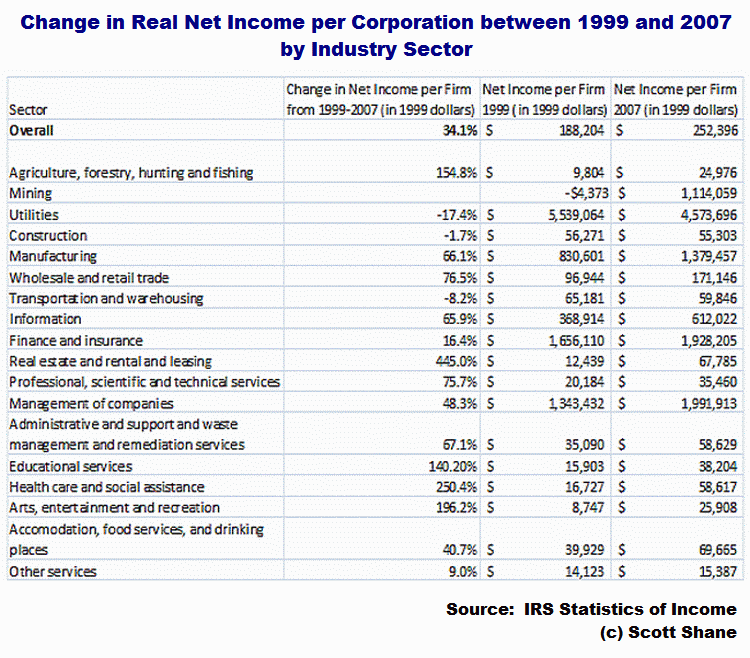
TheIRS Statistics of Incomeprovides some interesting data to show what has happened to the profitability of American corporations between 1999 and 2007 (right before the recession hit). Despite including the mild recession of 2001 and the dot com bust, these years were good ones for corporate America. The net income of the average American corporation increased by more than one third (34.1 percent) in real terms, reaching $252,396 (in 1999 dollars).

That sizeable increase begs the question: Why? The data suggest that one reason was by keeping costs in check. The average American corporation’s revenues increased only slightly in real terms between 1999 and 2007, but costs increased even less. As a result, the IRS data show that profit margins improved over the eight year period, with net income as a percentage of revenues at the average firm increasing from 5.7 percent to 7.6 percent between 1999 and 2007.

American companies were also worth significantly more in 2007 than they were in 1999. The net worth of the average American corporation increased 27.2 percent in real terms from 1999 to 2007.

Moreover, the net worth of American businesses increased relative to their sales. The net worth of the average corporation increased from 81 percent of one year’s revenues to 100 percent of one year revenues.

Of course, profitability and net worth didn’t increase in every industry. For example, the net income at the average utility shrank from $5,539,064 in 1999 to $4,573,696 in 2007 when measured in real terms.

The table below shows the net income per firm in 1999 dollars in both 1999 and 2007, as well as the percentage change between the two years for the 18 major sectors of the economy. Some of the numbers are a bit surprising, such as those for the average construction businesses, which made 1.7 percent less in real terms in 2007 than it did in 1999, despite the housing boom.

Change in Real Net Income American BusinessesClick to see larger version of above chart

In addition, the negative news about U.S. manufacturing not withstanding, net income at the average manufacturing business increased by nearly two-thirds in real terms between 1999 and 2007.

In short, in many industries, American corporations increased their net income substantially between 1999 and 2007, in part because they got better at holding costs in check. Maybe that pattern holds clues for how American business will behave during the current economic recovery. Rather than expanding hiring and building new operations, the average corporation may try to rebuild its profits by minimizing costs.


Source

суббота, 22 января 2011 г.

Small Business News: Social Entrepreneurship on the Rise

In recognition of Martin Luther King Day, we present a roundup about an important new trend, the rise of social entrepreneurship. Instead of profit, the social entrepreneur seeks social change. But, unlike the social reformer of only a generation ago, the social entrepreneutr goes about accomplishing this change using the tools and precision used in building a for-profit sustainable company. In a sense then, starting one of these new ventures is perhaps less like starting a non-profit organization and more like starting a small business. The product? A better world!

Basics

What is a social entrepreneur? Check John Garger’s definition:“…a change agent who works with missionary zeal to create and sustain social values.” Garger goes on to chart the shape of social entrepreneurship today, from a further definition to a comparison of social and business entrepreneurship, challenges of the social sector and more. Here’s social entrepreneurship 101 in a few digestible paragraphs.Bright Hub

Can social entrepreneurship be taught? One leading university has begun experimenting with teaching about social entrepreneurship in the classroom. Yale has begun instructing business students about the problems faced by social enterprises in the real world. What will be the result of a generation educated in the disciplines, needs and ideas of social entrepreneurship?Beyond Profit

Trends

Business schools embrace the social entrepreneurship ideal. Specifically, beyond simply studying the problems of social entrepreneurs as indicated above, the Kellogg School of Management at Northwestern University announces an $80,000 social entrepreneurship award. The funding will be granted to students proposing a business model addressing social or environmental challenges and will include mentoring opportunities. Stay tuned.Stacy Blackman

The growing trend of social entrepreneurship. Just like traditional entrepreneurship, social entrepreneurship, as an alternative to addressing social needs and challenges, may be gaining momentum not only in academia but among investors and a new generation of philanthropists less willing to hand out money to large foundations and other organizations. The key to success in social entrepreneurship, experts say, is to treat it like a business.National Public Radio

Success Stories

Some social entrepreneurship goals can be simple. In a world of high tech gadgets and gizmos, one opinion piece argues that one of the greatest social achievements still to left to accomplish is to provide this technology to a huge portion of the global population who still have little or no access to the bare necessities. This is the story of one such simple venture.NYTimes.com

Social entrepreneurship focuses on the underserved niche. Take the Excel Center of Indianapolis targeting the very real problem of high school drop outs. Unlike scores of other programs that focus the majority of their energies on keeping kids in school, however, the Excel Center focuses on a very different task, addressing the issue of too many drop outs by getting adults without high school diplomas back into school.Dowser

Resources

Top social entrepreneurship programs. Like top business schools, social entrepreneurship programs of high repute are springing up around the globe. These programs at top schools are a great place for future social entrepreneurs to start in their quest for creating business models that will bring us a better and more just world. Like more traditional business entrepreneurs, social entrepreneurs make change on their own by creating a sustainable model that helps achieve their goals.Beyond Profit

Finance

So, what do social entrepreneurs make? Maybe it seems like an inappropriate question in a business model not necessarily created to make a profit, but then again the concept of social entrepreneurship is about creating sustainable operations. That includes having enough money to pay someone to manage the company and therein lies the problem, because some social entrepreneurs are making little or nothing at all.Social Enterprise Network

Crowdsourcing social entrepreneurship. From small business owners to independent filmmakers, it seems everyone with an idea has jumped on board the crowdsourcing bandwagon. In fact, using crowdsourcing is a trend that should make sense to entrepreneurs since many must first approach those who know and believe in them including family and friends to fund their enterprises. What may be more surprising, is that social entrepreneurship did not latch onto this much sooner.Trailblazers for Good

Global

Promoting social entrepreneurship in Asia. Ashoka: Innovators for the Public announced the opening of an office in Japan this month. The new facility signals the U.S.-based organization’s first permanent presence in Asia. Ashoka has been instrumental in aiding social entrepreneurs the world over and the new headquarters demonstrates another step in that mission.The Japan Times


Source

пятница, 21 января 2011 г.

Want to Franchise a Business? 5 Sacred Rules to Become the Next Great Franchise

I’ve recently been engaged to help sell a very successful national franchise company and been able to observe firsthand many reasons why a franchise company grows to $10 million in sales through 600 nationwide locations.  Last year I also worked on the other end of the spectrum, helping two business owners locate the necessary capital and expertise to begin the journey of becoming the next great franchise company.

These two experiences have helped deepen my understanding of the five Sacred Rules that distinguish great franchise opportunities. I offer them here, in case you are considering converting your business into a franchise company.

5 Sacred Rules

Rule #1: Make your partners profitable.
This first rule sounds easy, but it often gets obscured by the economic pressures you will begin to feel preparing your financial projections. First and foremost, your concept must allow your franchisees to make a significant profit.  The more the better.

Yes, a unique, exciting concept is helpful in attracting attention and selling franchises, but the business process and procedures, both operations and marketing, must give your future business partners (franchisees) the opportunity to be successful financially. The more successful they can be, the more successful your franchise company will become.  If you maintain focus on this rule, many of your other challenges will become much smaller.

Rule #2: Have a great answer for the question,“What have you done for me lately?”
Creating ongoing value is critical for a successful franchise relationship. Once you have trained your franchisees and helped them establish their businesses, the value the franchisor contributes to their future success will diminish with time, at least conceptually.  Are your recipes unique and always changing? Does your scheduling system make your franchisees more efficient and profitable? Is your marketing process effective and inexpensive? Is your budgeting software critical to profitable projects? Does your real estate department help find great locations? These and other questions are ones franchisees will ask.

While a strong franchise agreement will protect the franchisor, the objective is to create a win-win relationship, and to continually innovate to make your business, service, marketing and products better.

Rule #3: Quit or hire.
Keep in mind you are embarking on an entirely new business endeavor in which you have no practical experience: franchising. You are no longer running your business and training others how to do the same; you are the CEO of what you hope will become a successful national franchise company.

I’ve seen many companies fail and wind up entangled in the legal system because they never make the full commitment to their franchise company.  Hiring a franchise development company to create marketing and sales documents and prepare your Federal Disclosure Document is enough to help you sell acouple of franchisees.  But if you want to become a meaningful and successful company, you have to support your earliest partners and make sure they are successful.

Christian Faulconer, CEO ofFranchise Foundry, offers some good advice here: Remember, if you decide to build a franchise system around your successful business, it’s like starting a second business. Selling your products or services to your customers will still require significant time and effort, but now you also have to find time to build the franchising infrastructure and market and sell your franchise opportunity. It can seem like you are running two separate businesses, and the demands can become overwhelming without the right partners.

Keeping your current full-time job as president of your business and then working in your startup franchise company almost never works out. Consultants don’t cut it, either. Make a commitment and either quit your job as president or hire someone to run the franchise business, but recognize you probably cannot be successful at both jobs at the same time.

Rule #4: Raise capital.
There are two reasons for this sacred requirement. First, it is a great reality check and screening mechanism.  When you begin to talk with others, friends, customers and especially franchise consultants, you’ll hear only positive feedback.  If you want toreallyhear the truth, ask for a check.

Consultants will tell you the idea is a sure success because they have a hammer and you are the nail. Friends want to support you and it is always easier to praise and encourage than provide constructive feedback. Your customers already love your service, so they are not the best ones to offer feedback on the viability of national expansion.

Kert Genningsis the COO ofBoardwalk Fresh Burgers and Friesand has grown two large food-service franchise companies. He offers this thought:“Preparing a formal business plan for converting your company into a franchise company is a very enlightening exercise as it will help you crystallize your thinking.  Once complete, use that document to raise the money you will surely need to have a fair chance at success.  If you cannot raise the money, listen to what the marketplace is telling you.  Not that you have a bad business, but that perhaps it is not ready for national expansion.”

Secondly, you will need the money you raise to help with marketing, sales, franchise support, registration in states that require it, and hiring a person to help run your old or new business (see point 3).

Rule #5: You must have a great selling process (selling is service and vice-versa).
You must have a process to sell your franchise to people you do not know. Ninety-five percent of your customers who tell you they are interested in becoming a franchisee will never write you a check.  And even if all of them do, it is not enough to create a viable business.  You need to sell to people you do not know. All successful sales are the natural outcome of asuccessful process.  If you want a great example of an automated process, you can visitProcess Peak.

Keep in mind, your initial franchisees will be early adopter personalities, risk takers. They will become franchisees because they like ground-floor opportunities and are easier to sell based on a concept and an opportunity.  However, when you update yourFDD, you are required to list your current franchisees (with contact info). Those people will become a critical part of your sales process weather you like it or not.  The key to your long term-success is how happy you make those early franchisees, and if you are cutting corners to save money or because you are not committed to the idea of franchising your business, their negative comments to prospective franchisees will really hurt future sales.

Keep in mind that franchising is a heavily regulated industry. TheIFAhas developed a process for selling franchises calledFranGuard. Your sales team should be familiar with that process and the steps you need to take to protect your system as you sell franchises.

Becoming the next great American franchise is a worthy goal, but there are many challenges along the way. Make sure you’ve done all of your research and identify partners who are truly vested in your future success.


Source

четверг, 20 января 2011 г.

Small Business News: The Global View

Whether you are large or small, there’s a huge market out there that at one time was much harder to connect with. It spans the surface of the Earth and is made up of people just like you and me. And some of them may want what you have right now. You no longer need to content yourself with a local market alone, a market that might either love or hate what you offer. Today there’s a different way for small businesses to think. And we’ve got the resource to get you there!

Tools

Managed services software helps small business compete globally. Delivering services remotely is a hug part of givcing even the smallest businesses a truly global presence. Where this service includes freemium services to start, the barrier for entry to become a global player becomes even lower. How could the ability to provide these services to customers anywhere in the world affect your business model.MSPMentor

Facebook ads give SMBs global reach. Like Google before it, Facebook has developed an advertising product that gives small businesses an opportunity to reach a global audience. Recent data suggests that, like Google’s highly successful AdSense model, Facebook’s self-serve advertising tool seems to have created the most interest amongst small businesses that might not have had the means to launch a global advertising campaign before.MarketingMag.ca

Healthcare

Opposition continues to mount for U.S. healthcare law. But while efforts to boost competitiveness abroad continues, the fight over an unpopular healthcare legislation at home still roils. The State of Wisconsin has officially joined numerous other states in the fight against a controversial U.S. healthcare reform legislation that business leaders in particular are concerned will detrimentally impact the U.S. economy by forcing some businesses and just about all citizens to purchase healthcare insurance.BizTimes.com

U.S. small business owners oppose reform legislation. Despite all the rhetoric for and against, a survey indicates the majority of small business owners in the U.S. would definitely like to see the controversial new healthcare reform being fought over in the courts repealed. These business leaders apparently do not buy assurances from healthcare reform advocates that the regulations will eventual lower heathcare costs.Business Wire

Policy

What would mandated paid leave for employees do to your business? Another concern for small to medium sized U.S. businesses struggling for a competitive advantage in the global economy is the debate over government mandated paid family leave. The Family and Medical Leave Act already grants up to 12 weeks of unpaid leave to American workers but does not require companies to pay them for the time off…yet. While advocates claim the U.S. needs the mandate, the reality is that smaller businesses probably cannot sustain such a cost and would likely respond with fewer full-time jobs in the future.msmbc.com

Trade

Import-Export bank to boost small business exports. In an effort to meet a goal set by the Obama administration the ration, the Export-Import Bank of the United States has announced plans to make more than 5,000 small businesses into U.S. exporters. Read more about the Global Access for Small Business and determine whether your small business could be a participant.123Print

British small businesses shun investment in developing nations. While U.S. small businesses have shown interest nin doing business with developing economies like India and China, a recently compiled report suggests their UK counterparts would sooner expand and invest in more developed markets like thosein the U.S. The report suggests the aversion may be due to the inherent risk these developing markets represent.The Economic Times

Tech

Social media map of the world! Thanks toShane Gibson who this week tweeted a map of the the world’s most popular media applications…by country! This incredible resource is imperative to anyone serious about using social media to expand the reach of your small business globally. This map, complete with overviews of each social media platform country by country and culture by culture goes WAY beyond  the old standbys of Facebook, LinkedIn and Twitter. Thanks Shane!AppAppeal

Building global brand with the social Web. There’s no need to go broke in order to start a global marketing campaign these days either. Arm yourself with knowledge (like the social media app above) and dive in. Create blogs, use free social media platforms. Connect with influencers, find your audience and then bring them to you.Reuters

Planning

A step-by-step for expanding your business globally. So, you want to take your small business global. Whether you have a lot of money or not, talking to or hiring consultants can only take you so far. In this post, Laurel Delaney has included a helpful link that takes you through the planning stages of going global with your venture, large or small. What are your plans for making your small business competitive in a new global economy? What major challenges do you face?The Global Small Business Blog


Source

среда, 19 января 2011 г.

The Many Payoffs of Green Business

In my job as a communications expert for an energy efficiency nonprofit, I get a lot of questions about payback: How long will it take for this or that energy upgrade to pay for itself through energy cost savings? This is an important question for any business trying to be fiscally responsible in this shaky economy.

But the straightforward financial return on investment of sustainability measures is only part of the reason businesses should be committed to reducing their environmental footprints today. There are a host of compelling long-term benefits that businesses reap once they embark on sustainability initiatives–and many of these benefits are ones they often didn’t initially bank on. Here’s a look at four “fringe benefits” of green business:

1. Opportunities for great publicity.Face it: As“green business” becomes more ingrained and trumpeted in the business world, more bloggers and mainstream media are covering it and looking to feature real-world examples.  Companies that take on ambitious sustainability endeavors – whether it’s going “carbon neutral” or starting an ambitious recycling initiative – can earn positive PR.Green start-upsalso generate great coverage. On the flipside, all this coverage of green practices today also means companies that ignore their environmental impact or engage in“greenwashing” are more likely to attract bad publicity.

2.Better employee engagement.Young adults today are paying more attention tothe social and environmental responsibilityof their employers or prospective employers. It’s cool to work for a company trying to change the world. Green practices are a way to engage employees in a good cause and help them feel more connected to the business.  Read thisrecent blog postby Taiga Company, a green business consultant, on how to bolster employee engagement by tying it to the company’s energy efficiency initiatives.

3.Healthier, more comfortable workplaces.Reducing a company’s carbon footprint often goes hand-in-hand with improving the workplace environment. New high-efficiency furnaces, for instance, burn cleaner than older inefficient ones.  Replacing gas-guzzling SUVs with a fleet of hybrid vehicles exposes your employees to less carbon emissions on a daily basis. Using less-toxic materials in your products means everyone will be healthier.

4.Time saved in the long run.Sure, putting together a full-blown sustainability plan–as I recommend businesses do– and putting together the research to do it takes time, commitment, money and thought. But once those plans reach fruition, the outcomes often save the company time. New equipment requires less maintenance than older equipment.  Less waste means less time collecting and hauling it away.


Source

вторник, 18 января 2011 г.

How to be a Fierce Competitor - Review

How to be a Fierce CompetitorYou have to love a book that does not beat around the bush. In an age of ever-escalating time management anxiety, sometimes you need a brief reminder of your business values and ethos. To learn about some business processes, a longer text is needed.  But for quick refreshers, you need a snack-size book that reminds you of key values (go ahead and picture those recent Snickers commercials with Betty White, Abe Vigoda, Aretha Franklin and Liza Minnelli).

Marketing strategy consultant Jeffery Fox offers a Snickers-level business reminder: a guide to competition and business success calledHow to Be a Fierce Competitor: What Winning Companies and Great Managers Do In Tough Times. Fox has written a few short books like this before, notablyHow to Become CEOandHow to Become a Rainmaker.  He gets straight to the point, and many of his zingers can be helpful to small business owners on the go and under, well, fierce competition. I bought a copy after I started flipping through a few of the pages in a bookstore; I have read How to Become CEOand wanted to see what new comments he had to share.

Tips to help you be the best competitor

The book does not give rambled musings about what you should do in business. Instead, the pages are an amalgamation of ideas, told crisply and distinctively.  Check out these few comments:

“Leaders respond and act. They may be wrong, but they don’t dither, dawdle, delay….Data deep dives are good, necessary, professional, but when you come up for air, that’s it. Decide.”

“In tough times the tough don’t start selling, they ratchet up their selling. Fierce competitors put more people out in the field selling. They make it possible for salespeople to make more money, not less.  They invest scarce dollars to visit and meet more customers. They don’t‘save’ money by quarantining their salespeople, by cutting advertising, by reducing customer service reps.”

“There are endless ways to let customers know you care.  Leave weekend voicemails, bring homemade cookies, make charitable donations in their names, let them be the first to know company big news before they read it in the paper.”

An interesting personal favorite is the tip“Stay Off Magazine Covers.” Here’s why:

“Profiles give competitors clues as to strategy, spending, capital budgets, and upcoming products….This information is fodder for analysts on the teams fighting to get your customers, your meal tickets, and your lunch.”

A fierce complement to many strategy books

The advice inFierce Competitoris very straightforward-no-chaser, likeRework, but the book’s pocket-sized journal structure is meant for general reminders that can add extra perspective to the reasoning behind more detailed works.

Some authors, like Stanley Bing, make the most of the journal structure with a witty tone that permeates from title to text.  Fox has his own style that accentuates  each raised point, with many of the comments focused on eliminating waste to manage growth and to operate for the best interests of your business.  In one instance he provides tips for eliminating a seemingly strategic client that in reality overwhelms your back-end processes.  He suggests you examine the cost to support that  “strategic” client, then:

“Give your competitors a present. Let them have the strategic account. Let the strategic account drain their resources while you redeploy to profitable current and future customers.”

For insight that feeds your mind, these thoughts are great, but keep the Snickers analogy in mind. Still, like the candy, this book will satisfy.  Fox leaves out bloated jargon, not good business sense.

Now, reading only one book does not make you a vital competitor.  You still need to dig into specific details, which is where this book helps most. How to Be a Fierce Competitorcan complement sales strategy, such asHow to Sell When No One Is BuyingandCompetitive Selling. General-topic entrepreneurship books such asKachingandTipping The Odds for the Entrepreneuralso work well as complements to this book. Finally, it also can make behavioral topics like that covered inClutchcome alive.

EnjoyHow to Be a Fierce Competitorand be entertained as well as reminded of your business sensibilities.


Source

понедельник, 17 января 2011 г.

Five Green Business Trends for 2011

It’s wasn’t so easy being “green” when the economy was blue. But as the U.S. economy looks brighter in 2011 – as most hope and expect it will— businesses will be more focused on long-term sustainability.

A key part of that is environmental sustainability.

Environmentally responsible business practices are quickly becoming a top priority for many businesses, as more realize the financial benefits and competitive advantages that come with it. But being a“green business” now and in the future will demand even more transparency over green practices and less tolerance for fuzzy green marketing.

Green Business Trends for 2011

Here’s a look at some green business trends to expect in 2011:

1.    Charting progress and success.Many big corporations like Microsoft and Walmart are creating teams of employees focused exclusively on environmental sustainability and have executives to oversee those teams. This will undoubtedly raise the bar for every company, large and small. More businesses will weave environmental sustainability into their business plans and budgets, writing full-blown sustainability plans and benchmarking their progress. Don’t be surprised to see more businesses devoting sections of their Web sites to describing their carbon- and resource-saving initiatives.

2.    Eco-managing the supply chain.It’s easy to unravel a company’s green image if consumers find out its products are sourced in environmentally unfriendly ways. So companies will continue to dig deeper into the green practices of their suppliers and hold them to higher standards, such ascreating supplier scorecards.

3.    LEDs get more play.As theNew York Times reportedlast summer, some LED (light-emitting diodes) light bulbs’ prices dropped to less than $20 in 2010, and prices are expected to drop substantially over the next few years. With lighting one of the biggest energy costs for so many businesses, a growing number of them are likely to start replacing older, less-efficient lights with LEDs, which use at least 75 percent less energy than incandescents and even less than compact fluorescent lights (CFLs). Moreover, many utilities are introducing rebates to make the upfront costs of LED lighting more palatable.

4.    Greater employee engagement.More companies are realizing they need their employees’ help identifying ways to reduce their environmental footprint. As a result, they will be communicating with employees more frequently about their green practices and soliciting new ideas, using green teams and other engagement techniques.

5.    Smarter green marketing. Companies are alsogetting savvierabout communicating their environmental sustainability initiatives with their customers and the public. More will be engaging their customers in the conversation in creative ways, launching public awareness campaigns about green issues connected to their business and helping their customers see why their green practices make a difference. Don’t be surprised to see more businesses devoting sections of their websites to describing their carbon- and resource-saving initiatives.

What will you be doing different with your green practices in 2011?


Source

воскресенье, 16 января 2011 г.

Small Business News: The Management Game

Are you playing the management game? Managing your small business is one of the most important things you do as an entreprener, but make no mistake. This isn’t child’s play. Here are some resources to get you thinking.

Research

Let your employees take at nap a work. What if someone showed you a way to increase overall productivity even if, in all other respects, it seems completely nuts. Well, before you start snickering and refuse to read any further, take a look at some of the data and perhaps you’ll realize it’s not such a crazy idea after all.UPrinting

Philosophy

Do your workers have a stake in your company? Watch this inspirational video about business leader and entrepreneur Jack Stack and a revolutionary method of entrepreneurship that not only opens the books for employees to see, but can transform your business and the people who work there for ever. What are you waiting for?Clutch Consulting LLC

Policy

Obama administration finally moving in a better direction? The announcement of a recent appointment is being applauded by some in the business community, but will a new chief of staff in the White House really have impact upon an economic policy that up until now has hardly seemed friendly to business? As we watch a new political management team take shape, what will it mean for small business in the U.S.The Ticket

New head named for the National Economic Council. Mainstream media is getting excited about“Small Business’s New Man in the White House” signaling a shift in the Obama administration’s economic policy. Gene Sterling has been described as the driving force behind a $30 billion small business and job bill aimed at loaning more money to small businesses. But with many small businesses more concerned about sluggish demand due to lower disposable income, we think the jury’s still out on whether the administration even knows where to begin.You’re The Boss

Strategy

Stop worrying about the New Year. Denise Fay would like everyone to stop stressing out about the big changes they need to make in their businesses in the New Year, because the fact is, change ion your business can be made at any time. More importantly, Denise believes you should work to make any changes in your company as stress free as possible. You can change anytime and that’s a better approach.Bloggertone

How creative are you in your business? We all know that business must be practical too. But come on, where do you think all that innovation comes from? Creativity was a huge part of how you created your business. Why shouldn’t it be part of how you run it too? We suspect this isn’t really something entrepreneurs need to learn. Just something they need to give themselves permission to do.Ability, Success, Growth

Personnel

Is there a right way to fight at work? Unless your business is a one man show, it requires other people to operate and make it profitable. These people are, of course, human beings and will not always get along. When they do not, problems will inevitably arise. When managing people to build your business, you must learn to handle both the highs and the lows. Here’s an evaluation of how to handle one of the low parts.  The Harvard Review

Jobs

Small businesses have created 57,000 new jobs. The numbers are for December, when records say small business contributed to plenty of hiring though few wages increased. It shouldn’t surprise anyone who manages a small business, that these companies will wind up the salvation of the economy. Let’s do all we can to support them!accountingweb

Services

Who’s managing your paperwork? Organizing your paperwork and other files can be a major issue when managing your small business and can really damage your productivity. Having someone organize your stuff can really save you time and money. Enter a whole new kind of small business whose function is just that. Do you need someone to manage your small business information.  Los Angeles Times

New online service spots payment risks. Thinking about extending credit to a potential customer in order to keep them on or make that sale. A new online service creates an up-to-the-minute picture of the customer or client’s payment history to let you know whether the risk is justified. Wouldn’t you like to manage the risk of non-payment in your small business? Learn more today.Star Tribune


Source

суббота, 15 января 2011 г.

Small Business News: Twitter Tycoons

With just 140 characters, Twitter has changed what it means to communicate. And, in case you haven’t noticed, the way we do business too. If you aren’t using Twitter, talk to someone who does. Find out why they do and what Twitter has done for their business. With such simplicity and such versatility, there are probably as many uses for Twitter as there are entrepreneurs and small business owners. Find out more about how and why the small business community is using Twitter (and how you probably shouldn’t use it) below:

Marketing Basics

How Ivan Walsh makes money on Twitter and how you can too. Seriously, too much discussion about Twitter (and most other social media, for that matter) is about building relationships. That’s fine, but it doesn’t really begin to scratch the surface of how social media can and is being used to build small business revenue, not just brand. Here’s more.Bloggertone

Selling your tweets? If you were to do so, (and John Jantsch isn’t suggesting you do) how valuable would they be? Whether you decide that selling tweets is beneficial to your business model or not, one thing is for sure. Using the tools available for monetizing your tweets will give you a better idea of the true value you are passing on to your community.Duct Tape Marketing

12 tips for Twitter marketing. The world’s most powerful and famous micro blogging platform is not a silver bullet. Tweeting will not guarantee your success, so before you begin sharing your 140 character messages with the world, be aware that certain strategies lead to success in your Twitter community while others may not.Business2Community

Bast Practices

Why you should NOT pay for Twitter followers. Joel Libava, The Franchise King, bears his soul in this post about the importance of authenticity in the Twitterverse (and by extension through the rest of the social media sphere.) Joel’s story explains why it’s not about the numbers but about the quality of people you pull into your orbit.Franchise Social Media Marketing

Trends

What is a Twitter chat? And how can it help you to market your expertise and brand to the greater Twitter community. Matt Mansfield gives us a tour of this important phenomena which turns the most popular micro blogging tool in the world into a chat room or instant message board for a few hours each day for tweeps who like to meet and discuss a variety of topics important to them. What would you like to chat about on Twitter?Matt About Business

Are you a Twitterholic? Do you sit for hours frittering with Twitter. While the popular social media platform has incredible potential to drive business, revolutionize communications and build traffic and community around your product, service or brand, it also has an incredible potential to suck the life out of you if you just sit around staring at it all day. Here, from John Wheeler, are 10 signs to let you know you’re in trouble.BizNetCentral

Tools

Chrome extensions for Twitter and how to use them. Just like any other tool in your small business tool box, Twitter comes with special attachments to make it work better. This is even more the case with the introduction of the new Twitter upgrade. While special tools to enhance Twitter management like HootSuite had users essentially staying away from the site proper and managing their accounts from afar, it’s time to roll up your sleeves and get your hands dirty with a whole new generation of Twitter tools.Basic Blog Tips

Feedburner updates enable new features for Twitter. The service that revolutionized the publication of blogs has added real time and social features that will change the way you use Twitter to publicize your content and how you can use FeedBurner to track efforts in the social media sphere. Check out this video overview from Ileane Smith of Basic Blog Tips and follow along.Codex WP

Tips

10 pieces of Twitter and FB advice to make your small business soar. The two most popular social media platforms can easily be used in conjunction and that’s what plenty of folks do. In fact, as Nicole Smith of Blue Fish Social Media suggests, the two platforms make up the“cheapest, fastest& most effective advertising” available for your brand.Business Review Australia

Anti-social behavior in the social Twitterverse? Remember that in social media, being social is everything. And so Web development specialist Jennifer Devitt is kind of scratching her head about Twitterers who ask others to validate their accounts before allowing them to follow. Sure we all understand the desire to make sure the person following you is a real human being. But in the end, what message are you sending to others who want to interact with you?Sydcon Web Development Inc.


Source

пятница, 14 января 2011 г.

Small Business News: Building Better Strategy

Building a better strategy should be the constant goal of every small business owner and entrepreneur. Think your business is running as well as it can, has grown as far as possible, has no room for improvement in terms of efficiency. Even if you believed all of this, let’s not forget that in today’s highly competitive economy, things will always be changing. Adapting your strategy to adjust for that change is, at the very least, key to your company’s survival. Here are some tips for improving your strategy today.

Getting Organized

Your strategy for starting 2011 right. Often running a business well comes down to organization and the importance setting things up effectively from day one for your business to succeed. Here’s a checklist that should help you build a strategy either for running an existing business more effectively in the new year or for starting a new business and getting it off the ground successfully in order to insure success. Personal Dividends

The best plan for getting organized. Following the theme of getting organized as a strategy for getting your business ready to go in the New Year, here’s a step-by-step for those of us who always seem to be playing catch-up without as much of a strategy as perhaps we should have. The first step, by the way, is that this will take time!Entreprenant

Adopting a Plan

Got a strategy? Why not share it? Seriously, Sarah Mitchell suggests, if you’ve got a plan to grow your business, products or services, reaffirm your mission and insert a bit more personality in your brand, why not turn it into content and transform it into marketing. She’s even got some samples. If you’ve got a strategy to make 20011 awesome, don’t keep it a secret. Share it with your customers. Global Copywriting

Why you need to set goals…NOW! Want to set a course for your business? First you’ll need a destination. Are there outcomes you would like to change. Formulate them into actionable goals then watch what happens. Too many small business owners let their businesses happen to them. There’s a better way. It starts with a decision to make things better.Clutch Consulting LLC

Social Media

Social media: What are you doing wrong? The social media revolution has certainly changed business, perhaps as much and as completely as online search and the concept of the Internet itself. But now that businesses large and small have begun to develop social media strategies, the big question remains, what will work and what will not.Forbes

What do you want from your community? A big part of any strategy, is knowing what outcome you hope to achieve. If this sounds obvious, remember that a large part of the problem small business entering the social media sphere experience in terms of ROI has to do with not fully determining what they want from their campaign in the first place. It’s not just nice to have a strategy for Twitter and Facebook, it’s vital!Professional Door Dealer

Adopting a Foursquare strategy. Marketing consultant Fiona Bosticky gives this detailed overview of the geo-location site and shows us why, with Foursquare’s new focus on venue owners and brands, managing a Foursquare presence must be looked at as much more than simply a part of your social media campaign. It needs a strategy of its own.Abnormal Marketing

Time Management

Sometimes a strategy involves doing less. Could it be that the key to your success has less to do with what you do than with what you don’t? Could the answer to creating a more efficient business strategy and a better life strategy for yourself as an entrepreneur is less about how many things you can fit into a day…and more about making more time for the things that matter? Adopt a strategy that cuts out wastes of time and effort and see how this changes the outcome in your business.ScottFox

Outlook

Set your goals then enjoy the ride. OK, you may be thinking that setting the goals implies a laser-like focus later as you follow them to your eventual goal. After all, who puts together a strategy and then fails to follow it to its logical conclusion. But, as Frederique Murphy suggests, part of the idea is to enjoy the ride. Your goals and strategy will still be there. But don’t miss the trip while working to attain them. Your strategy is a road map, but they shouldn’t prevent you from enjoying the ride.Mountain Moving Mindset

Survival Strategy

Planning for disaster. Finally, not all strategy should be aimed at meeting your goals. Some must also be about preparing for unexpected outcomes. How would your small business fair in a disaster? Do you have the strategy in place to cope? Of course, disasters are the kinds of things everyone want to believe will not occur. But do you have a strategy to meet an emergency if it should arise?Grow Smart Biz


Source

четверг, 13 января 2011 г.

Web 2.0 Pays Off for Businesses

How is your company using Web 2.0? (Oris it?)McKinsey& Company recently released the results of a surveyof how more than 3,200 companies in a range of regions and industries use Web 2.0 tools and technologies. Companies were asked about the business benefits and organizational impact of 12 Web 2.0 technologies: blogs, mashups (a Web application that combines multiple sources of data into a single tool), microblogging, peer to peer, podcasts, prediction markets, rating, RSS, social networking, tagging, video sharing and wikis.

In this fourth year of the study, Web 2.0 continues to grow. Two-thirds of the respondents reported using Web 2.0 tools in their organizations. The percentage of companies using social networking (40 percent) and blogs (38 percent) rose significantly, as did the number of employees using Web 2.0.

Web 2.0 Pays Off for Businesses

And those numbers will only increase. Two-thirds of respondents who are currently using Web 2.0 say they plan to boost future investments in these technologies, compared with slightly more than 50 percent who said they would increase spending last year.“The healthy spending plans during both {2009 and 2010} underscore the value companies expect to gain,”the study reports.

Now, this being a McKinsey study, the companies surveyed were not exactly small businesses.“So what does this have to do with my company?”you may be asking. Here’s why you should care, and why—if you’re not already implementing Web 2.0 tools in your business—it’s time to get cracking: Nine out of ten respondents said Web 2.0 technologies resulted in at least one measurable business benefit.More specifically:

When working with customers, businesses reported Web 2.0 led to:

  • Increased marketing effectiveness– 63 percent
  • Increased customer satisfaction– 50 percent
  • Reduced marketing costs– 45 percent

When working with suppliers/partners, here’s what they reported:

  • Increased speed of access to knowledge– 57 percent
  • Reduced communication costs– 53 percent
  • Increased satisfaction of suppliers/partners– 45 percent

There were even measurable results internally: 77 percent of respondents said use of Web 2.0 technologies gave them faster access to knowledge within the company. (In other words, it helps you get things done faster—and every entrepreneur knows how crucial that is.)

However you slice and dice this study, it proves two things: One, that businesses can derive measurable benefits from Web 2.0; and two, that you’d better get in on the Web 2.0 game—because big companies certainly are.


Source

среда, 12 января 2011 г.

Five Things Learned From Twit-Stalking Competitors

In life, I get away with quite a bit thanks to an innocent face and my ability to become doe-eye on command. On the Internet, I get away with even more because I’ve learned how to act unseen and keep an eye on my competitors without them even knowing. And that’s one of the greatest gifts we have through social media – the ability to track our competitors without them feeling our glance. One of my favorite tools tostalkmy competitors is Twitter. What can I learn about my competition strictly by watching and analyzing their Twitter accounts?

Grab a pen. Here are a few of my favorite things.

1. The Basic Account Goods

The first step of competitor stalking is to analyze the basics of their account. Bring up their Twitter profile and take note of:

  1. Where does their profile link to? Does it link to their Web site, their Facebook account, a social media landing page?
  2. What’s their Follower/Following ratio? Are more people following them or do they follow more people? Are they following so many people that it looks unnatural or does it look like they’re building the account by hand? What kind of following strategy does it look like they’re using?
  3. How many tweets do they have?: Are they an active Twitter users are have they only sent out a couple dozen? How many times do they tweet a day? Are their tweets mostly replies to other users or standalone tweets? Are they posting their opinion, news stories, spice-of-life tweets?

Many people will ignore the bio box on a user’s Twitter profile simply because it’s so small, but there’s quite a bit of information to be had there if you take the time to look.

2. What Twitter Tools They Use

With how quickly new social media tools emerge and the different features offered I like to keep track of what tools my competitors are using. Knowing this gives me an idea of what kind of statsthey’retracking, whether or not certain updates or automated, or what plugins they’re using to help users share their content. For example, did you knowChris Broganuses Hootsuite,Scott Strattenuses UberTwitter, andSMB social networking siteBizSugar uses Social Oomph?


Well, now you do. And knowing that will help you understand their strategy a little bit, while also keeping your eyes open to new tools.

3. What Kind Of Conversation They Have

Whether you use a tool like TweetDeck or just have a saved Twitter Search handy, keep an eye on the conversations that your competition is having on Twitter. How are they replying to their customers? Do they reply to everyone who mentions them? Are they around to answers questions in real-time? Is there an opportunity for you to jump in and claim some of their leads? If you notice that your competition is replying to customers infrequently or not hopping into conversations about their brand, then you know they probably haven’t put together a solid social media campaign and they’re just haphazardly using it. However, if it looks like they’re monitoring keywords, jumping on “anyone know…” type searches and being all-stars at Twitter customer service, then it may be a sign that you need to ramp up your own efforts.

4. What Kind of Twitter User They Are

To say there are a lot of Twitter tools available to help you analyze your competitors account would be a huge understatement. Because there are more than“a lot”. And there’s a new one popping up every day. Below are some of the Twitter tools I’m partial to and a look at how I use them.

  1. Twitter Grader: Twitter Grader is a free tool that lets you skulk out the power of a user’s Twitter account and compare it with your own. This tool was among the first Twitter tools out of the gate, so it remains one that I’m partial to. You can see the accounts “grade” out of 100, a snapshot of the top followers of that account, and a graph of their user history to see how quickly they built their followers.
  2. Twitanalyzer: Twitalyzer is another service aimed at analyzing accounts. They’ll score the account, tell you the Influencer Type* {built off a post I wrote for SmallBizTrends on theFive Types of Influencers On The Web}, the subjects that user typically tweets about, and a look at some of the faces in that person’s network.
  3. Klout: Klout is another social media tool that’s getting a lot of attention right now. I like this tool for it’s ability to scout out influence networks and attempt to quantify social metrics like total reach, mentions, Retweets and other things. Over on my company blog Outspoken Media, I’ve shared how we use Klout totrack down influencersand for othersocial media services.

5. Find their Other Social Accounts

If your competitor has a YouTube channel, they’re probably going to share that content on Twitter. If they have a blog, they’re going to drop the URL to direct their customers there. If they have an emails newsletter, they’re going to want to make sure their Twitter followers are aware of that. By keeping an eye on their tweets and wherethey’re linking to, it helps you stay up to date on how they’re using these other channels, as well. We always say how important it is to cross-link social media accounts, right? Follow the trail.

Social media gives you an unparalleled opportunity to connect with users. Italsogives you a unique opportunity to watch your competitors in the wild without them knowing. Are you taking advantage of it?


Source